An Indian minimalist jewellery and accessories brand running on Shopify scaled hard into an End of Season Sale using Meta Advantage+ Shopping Campaigns and Google Performance Max. Order volume exploded to 5,003 daily orders, but the next morning, the settlement math broke. Clevrr AI showed that while Meta claimed a 4.5x ROAS and Google claimed a 5.0x ROAS, the actual backend marketing efficiency ratio had collapsed to a loss-making 1.9x. The engine traced the leak to coupon stacking inside the EOSS collection, a severe AOV band shift into low-ticket baskets, and paid spend pushing sub-Rs 500 checkout behaviour at scale. In this, Clevrr AI helped the team isolate the exact coupon and buyer cohort causing the bleed and stabilize profitability within 24 hours.
-Rs 6.43L
Net Sales Drop | 5,003
Daily Orders | 1.9x
True MER | 24 hrs
Fix Window |
THE PROBLEM
Paid channels looked efficient, but the brand was scaling loss-making orders.
The danger in this was not weak demand. Demand was strong. The danger was believing the ad dashboards. Meta ASC and Google PMax both appeared healthy because each platform was taking credit for overlapping conversion paths. But Clevrr AI's backend lens told a different story: true blended efficiency had collapsed, AOV had fallen from a typical Rs 2,400 to Rs 1,200, and a large share of orders was now coming from low-value baskets that could not carry discount pressure and paid acquisition costs together. At the same time, a Shopify coupon-stacking loop inside the EOSS collection pushed margin dilution even further, making high order volume feel like success while the business was actually leaking profit.
What They Already Tried
Reviewing Meta ASC ROAS, checking Google PMax returns, and validating Shopify sales totals after the budget scale-up. | Why That Failed
Platform views could show attributed efficiency in isolation, but not prove whether the actual order mix, AOV collapse, and coupon behavior were making the sale fundamentally unprofitable. |
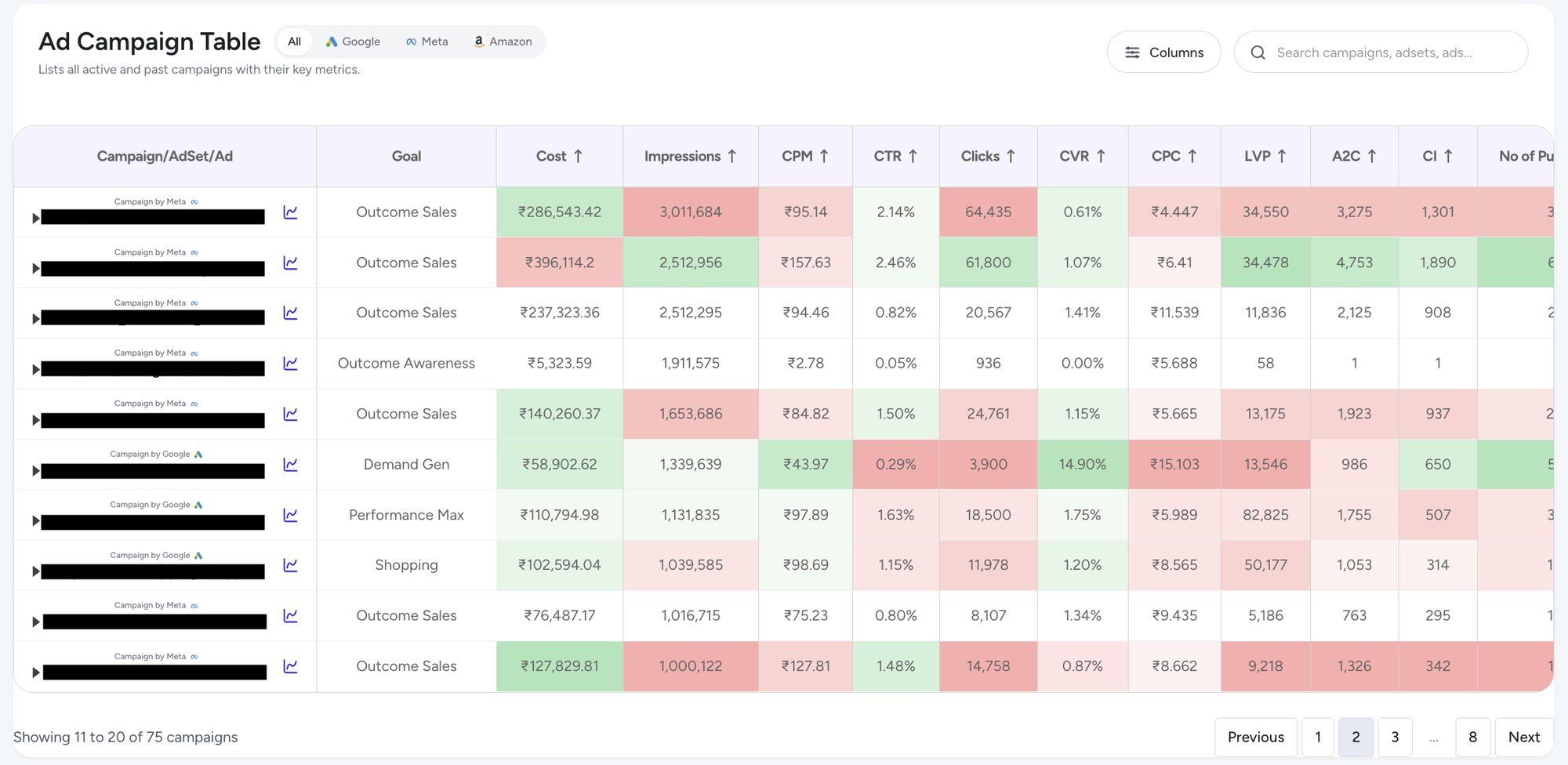
*Image has been blurred to protect proprietary client data.
The team did not need another performance screenshot. It needed a unified paid RCA system that could reconcile reported ROAS with backend revenue quality and pinpoint exactly where the margin leak lived.
WHAT WE BUILT
We used Clevrr AI to connect paid attribution, AOV bands, and discount behavior in one RCA path.
Clevrr AI became the operating layer across Shopify, Meta, and Google. Rather than treating paid-media ROAS, order count, AOV, and discount logic as separate diagnostics, the RCA engine walked the team through a single metric tree: Net Sales to Orders to AOV to Discounts. That lets the brand identify whether the problem sat in conversion scale, basket value, or discount leakage, and then translates the diagnosis into concrete campaign and storefront changes the same day.
PILLAR 1
The RCA Tree Exposed the Gap Between Platform ROAS and Real Revenue
Platform Illusion
Meta 4.5x and Google 5.0x ROAS looked strong on their own dashboards. | Backend Truth
Clevrr AI reconciled those claims against Shopify revenue and true blended spend. | MER Reality
The brand's actual MER was only 1.9x, well below a safe efficiency line. |
This was the first critical unlock. Clevrr AI proved that reported paid efficiency was being inflated by duplicate attribution across channels and that the real issue was not missing volume. It was poor revenue quality relative to total paid outlay.
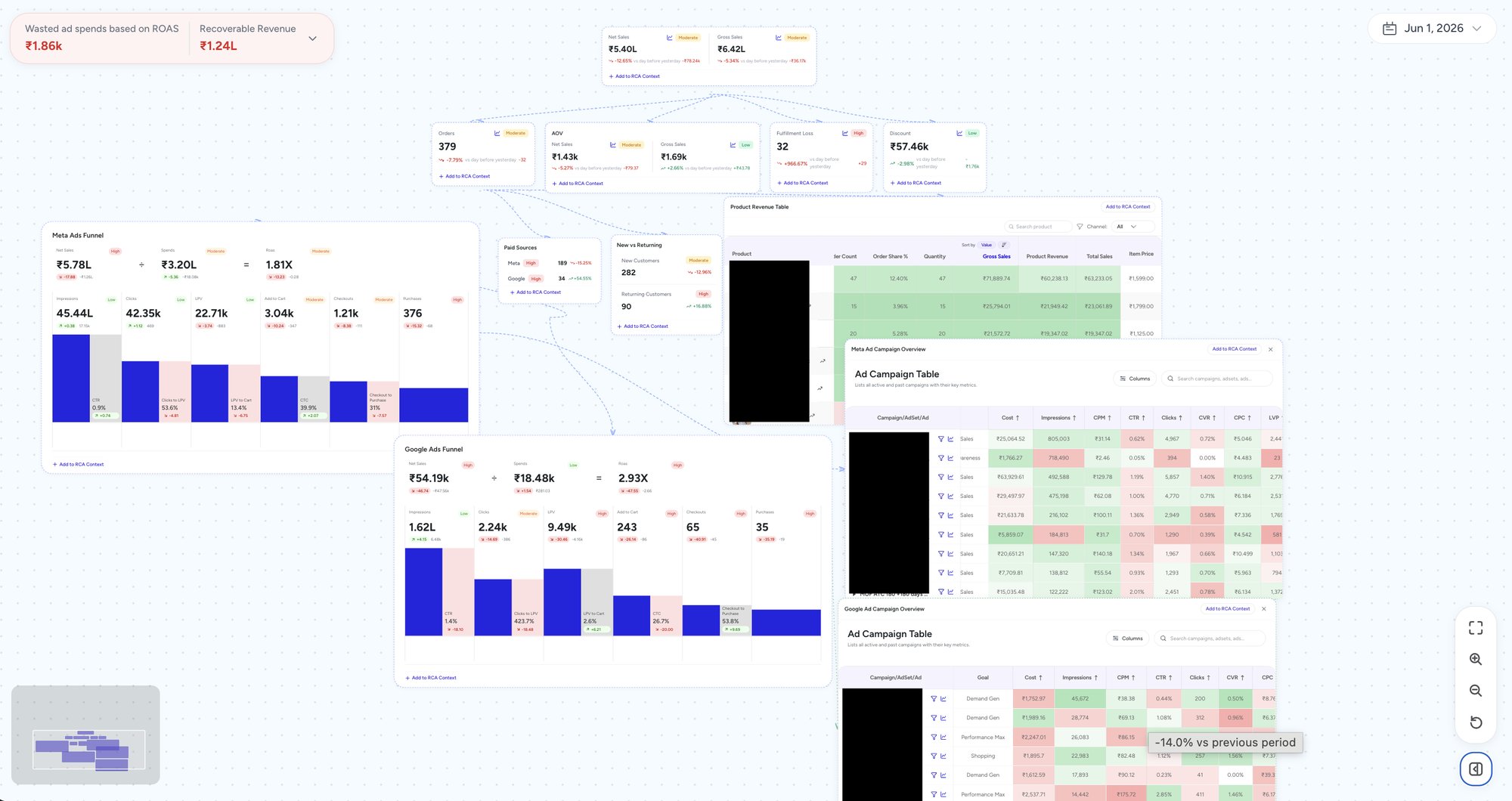
*Image has been blurred to protect proprietary client data.
Impact: The team moved from trusting surface ROAS to managing on true blended economics.
PILLAR 2
Collection Tables and Coupon Logic Isolated the Margin Leak
Holiday / EOSS Collection
3,800 orders came from the main sale collection, but the margin fell to 22%. | Coupon Stack
An automated Shopify discount loop amplified promotional depth beyond the plan. | Leak Trace
Clevrr AI tied the revenue damage to the specific collection and coupon behavior. |
The sale itself was not the only problem. The sale mechanics were broken. Clevrr AI showed that the largest order-driving collection was also the largest source of value destruction because stacked discounts were compounding against already lower-margin inventory.
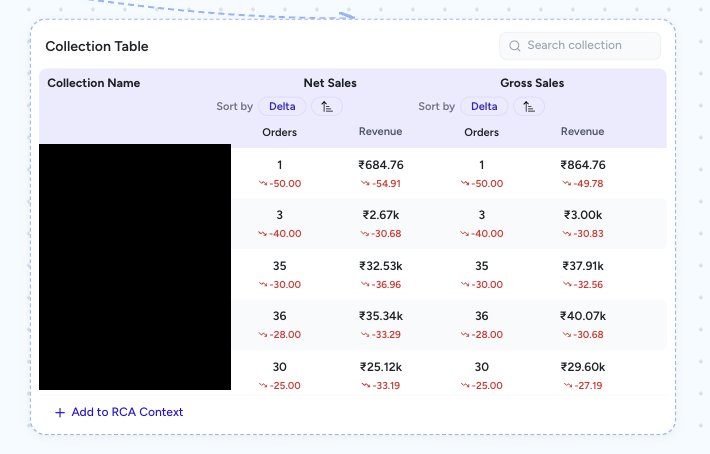
*Image has been blurred to protect proprietary client data.
Impact: The team identified the exact collection and coupon path that had to be stopped first.
PILLAR 3
AOV Bands Revealed That Paid Scale Had Shifted Into Weak Buyer Quality
Low-Tier Concentration
Seventy percent of orders moved into the Rs 500-Rs 1,000 band. | High-Value Thinning
The Rs 2,001-Rs 4,000 band fell out of the mix almost entirely. | Waste Bucket
Fifteen percent of the budget was scaling sub-Rs 500 checkout items. |
Clevrr AI made it obvious that the brand had not just discounted harder. It had changed who it was buying and what they were buying. Paid media was now fueling a low-value buyer cohort whose baskets were too small to support aggressive spend and sale depth together.
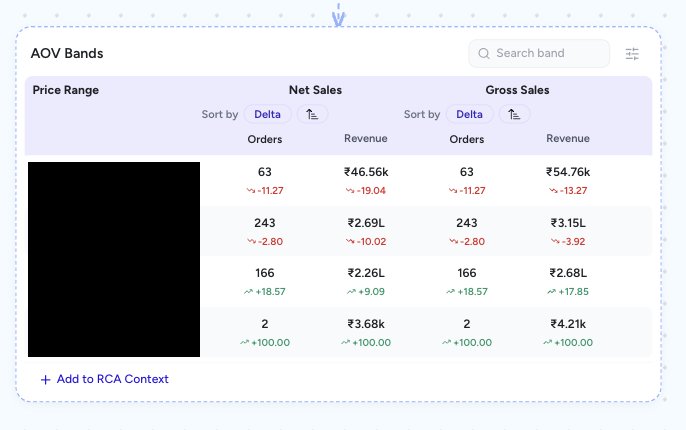
*Image has been blurred to protect proprietary client data.
Impact: The AOV collapse became attributable to a specific price-band and buyer-quality mix, not just general sale pressure.
PILLAR 4
The Recovery Plan Reset Both Storefront and Paid Constraints
Shopify Fix
Kill the coupon stack and restore controlled discount logic immediately. | Google PMax Rules
Rebuild asset grouping around minimum cart-value and premium collection signals. | Meta ASC Revision
Pull spend away from discount-stacked collections and suppress low-value buyer paths. |
Clevrr AI turned the RCA output into a tactical remediation protocol. The brand did not simply reduce spend. It reset the economic rules of the sale by stopping discount leakage, tightening which products could scale in paid, and shifting budget away from cohorts that were driving orders without profit.
Impact: Profitability stabilization became possible within the next operating cycle rather than after a long postmortem.
THE RESULTS
Once the brand stopped reading ROAS as profit, the right fixes became obvious.
Metric | Normal Day | EOSS Spike | 24h Fix |
Net Sales delta | Baseline day | -Rs 6,43,058 | The majority recovered within 24 hrs |
Average order value | Rs 2,400 | Rs 1,200 | Rs 1,980 |
The platform reported ROAS | 3.8x blended | 4.5x-5.0x | 3.9x |
True blended MER | 3.0x | 1.9x | 2.8x |
Orders in the Rs 500-Rs 1,000 band | 34% | 70% | 43% |
Orders in the Rs 2,001-Rs 4,000 band | 29% | 11% | 23% |
Margin on EOSS collection | 41% | 22% | 35% |
Paid budget wasted on sub-Rs 500 baskets | 5% | 15% | 6% |
The sale did not fail because the paid demand was weak. It failed because paid scale, coupon logic, and basket mix were allowed to combine into a margin-negative growth loop. |
THE TAKEAWAY
Clevrr AI helped the team separate order growth from profitable growth in one operating loop.
Economic challenge: High-volume sale periods can look healthy inside ad dashboards while backend economics collapse through duplicate attribution, discount stacking, and weaker basket quality.
Mindset shift: The team stopped optimizing toward reported platform ROAS and started managing toward blended MER, AOV quality, and cohort profitability.
Customer insight: Low-value paid buyers and discount-stacked collections can quietly dominate order mix long before the total order count looks unhealthy.
Measured outcome: Clevrr AI traced the leak to one collection, one discount mechanic, and one low-value cohort pattern quickly enough to restore control within 24 hours.


